
Launching a sportsbook requires more than choosing a domain name and adding betting markets. Operators also need reliable technology to manage odds, player accounts, payments, risk, security, reporting, and the overall betting experience.
One of the biggest technology decisions is whether to use white label sportsbook software or build a custom sportsbook.
Both options have advantages and limitations. A white-label solution can provide an established technology platform that is faster to launch, while a custom sportsbook gives an operator greater control over the product and its functionality.
The right choice depends on the operator’s budget, technical resources, target market, business goals, and desired level of control.
What Is White Label Sportsbook Software?
White-label sportsbook software is a ready-made betting platform provided by a third-party technology company. The provider supplies the underlying technology, while the operator launches the sportsbook using its own brand.
Depending on the agreement, the provider may handle areas such as platform infrastructure, odds feeds, betting markets, payment integrations, account management, and technical maintenance.
The operator generally focuses on branding, marketing, customer acquisition, promotions, and day-to-day business operations.
For a broader explanation of sportsbook technology, features, pricing considerations, and provider selection, see our complete guide to sportsbook software.
What Is a Custom Sportsbook?
A custom sportsbook is developed specifically for an operator or built using a highly customizable technology framework.
Instead of starting with a standard platform, the business can define how the website, betting interface, back office, integrations, and other components should work.
Custom development can provide much greater control over the user experience. However, it normally requires more development resources, testing, maintenance, and technical expertise.
A custom platform may be appropriate for an established operator that has specific requirements that cannot easily be achieved with a standard solution.
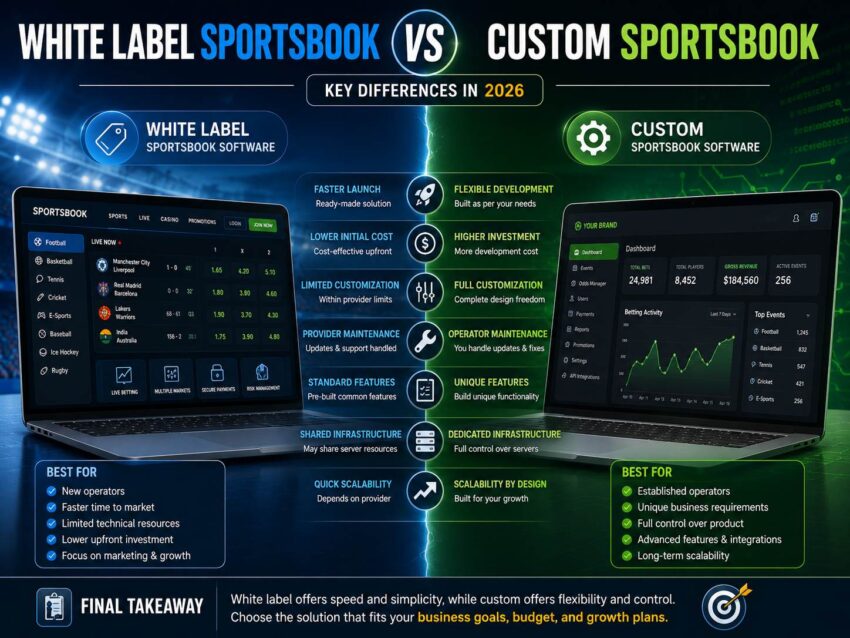
White Label vs Custom Sportsbook: At a Glance
| Factor | White Label Sportsbook | Custom Sportsbook |
|---|---|---|
| Launch time | Generally faster | Usually longer |
| Initial development | Lower | Higher |
| Customization | Limited to provider capabilities | Extensive |
| Technical control | Provider-led | Operator-led |
| Maintenance | Often handled by provider | Mainly operator/development team |
| Scalability | Depends on provider | Can be designed around requirements |
| Technology ownership | Usually provider-based | Greater control for operator |
| Best suited for | Faster market entry | Businesses needing unique functionality |
The table provides a general comparison. Actual terms vary between providers and development companies.
1. Launch Time
One of the biggest advantages of a white-label platform is speed.
Because the underlying technology has already been developed, an operator does not need to build every component from scratch. Branding, configuration, integrations, testing, and other launch activities can be completed using an existing framework.
A custom sportsbook generally takes longer because the development team must design, build, integrate, test, and maintain the required functionality.
For a business that wants to enter the market quickly, this difference can be significant.
2. Cost and Investment
White-label solutions can reduce the amount of upfront development investment because the operator is using existing technology.
However, this does not mean a white-label sportsbook is always inexpensive. Costs can include platform fees, setup charges, revenue sharing, data services, payment processing, customization, and other third-party services.
Custom development usually requires a larger initial investment. The operator may need developers, designers, project managers, infrastructure, security resources, and ongoing maintenance.
The long-term cost should therefore be considered rather than comparing only the initial launch price.
3. Customization
Customization is where custom sportsbooks have a clear advantage.
With a custom platform, an operator can potentially control the design, navigation, betting interface, account system, dashboards, integrations, and specialized features.
White-label platforms can also offer customization, but the level depends on the provider. Some may allow extensive branding and configuration, while others provide a more standardized interface.
Before selecting a white-label provider, operators should ask exactly what can and cannot be changed.
4. Technology and Technical Control
With white-label software, much of the technical infrastructure remains under the provider’s control.
This can be beneficial because the operator does not need to manage every technical component. Updates, infrastructure, bug fixes, and platform maintenance may be handled by the provider depending on the agreement.
With a custom sportsbook, the operator has more control over the technology but also takes on greater responsibility.
This can mean maintaining development teams, monitoring infrastructure, fixing issues, applying security updates, and managing integrations.
5. Sports Data and Odds
Both models can support sports data and odds, but the implementation may differ.
White-label providers often have existing connections with sports data and odds services. This can simplify the process for an operator.
A custom sportsbook may require the development team to integrate data feeds separately. This provides greater flexibility but also increases technical responsibility.
Operators should examine the quality, coverage, update speed, and pricing of the data services available with either option.
6. Payments and KYC
Payment processing and customer verification are important components of any sportsbook.
A white-label solution may already support certain payment gateways and KYC services. This can make integration easier, especially for operators entering a market where supported services are already available.
Custom platforms provide more flexibility in choosing integrations, but those integrations must be developed, tested, maintained, and updated.
The availability of payment methods should always be checked against the operator’s target market and applicable regulations.
You can learn more about the technical components involved in running a sportsbook in our guide to online sportsbook software.
7. Security and Compliance
Security should be a priority regardless of which development model is selected.
A sportsbook handles customer information, account credentials, betting activity, and financial transactions. Weak security can create serious operational and reputational problems.
With a white-label solution, the provider may manage significant parts of the technical security infrastructure. However, operators should still understand what security responsibilities remain with them.
With custom development, the operator has more control but also needs to ensure that security is properly designed, tested, monitored, and maintained.
Compliance is another separate consideration. Software does not automatically make an operator legally compliant. Licensing, KYC, responsible gambling, advertising, data protection, and other obligations depend on the jurisdiction in which the sportsbook operates.
8. Scalability
A sportsbook should be able to handle growth.
As customer numbers increase, the platform may need to process more account activity, betting transactions, requests, and data.
A good white-label provider should be able to explain how its infrastructure handles increasing traffic and betting volumes.
With custom development, scalability can be designed around the operator’s expected requirements. However, the operator is also responsible for making sure the infrastructure can handle future growth.
Scalability should therefore be discussed before launch rather than after traffic increases.
9. Maintenance and Updates
Technology requires continuous maintenance.
White-label providers commonly handle a significant portion of platform maintenance, although the exact responsibilities depend on the contract.
This can be useful for operators that do not want to maintain a large technical team.
A custom sportsbook requires ongoing development and maintenance. Software updates, security improvements, new integrations, bug fixes, performance optimization, and feature development all need to be managed.
This additional responsibility should be included when calculating the total cost of a custom platform.
10. Which Option Is Better for a New Operator?
For a new business with limited technical resources, a white-label solution can be a practical starting point.
It can provide access to established technology without requiring the operator to build an entire sportsbook from the ground up.
However, the operator should carefully review the provider’s contract, integrations, customization options, pricing, support, and technical capabilities.
A custom sportsbook may make more sense for a business with experienced technical teams, substantial resources, and a clear need for unique functionality.
When Should You Choose White Label?
A white-label solution may be suitable if:
- You want a faster route to market.
- You have limited development resources.
- You want an established technology platform.
- You prefer the provider to handle much of the technical maintenance.
- Standard sportsbook functionality meets most of your requirements.
- You want to focus more heavily on branding and marketing.
The important point is to choose a provider that offers enough flexibility for your business rather than selecting a platform based only on launch speed.
When Should You Choose Custom Development?
Custom development may be worth considering if:
- You need unique sportsbook functionality.
- You require extensive control over the user experience.
- You have an experienced technical team.
- You need specialized integrations.
- Your business model differs significantly from standard sportsbook operations.
- You expect technology to be a major competitive advantage.
Custom development can provide greater freedom, but that freedom comes with greater responsibility and investment.
Questions to Ask Before Making a Decision
Before choosing either approach, operators should answer several practical questions:
What is the launch timeline?
If speed is critical, building everything from scratch may not be practical.
How much customization is actually required?
If standard features meet most requirements, a white-label platform may be sufficient.
What technical resources are available?
Custom development requires ongoing technical expertise, not just a development budget.
What is the long-term business strategy?
A platform that works for a small operation may not be ideal for a business planning rapid international growth.
What is included in the provider’s pricing?
Check platform fees, data feeds, integrations, support, maintenance, and customization charges.
Who owns the technology and data?
Contractual terms can vary, so operators should understand their rights and responsibilities before signing.
Final Verdict: White Label or Custom?
There is no universal winner between white-label and custom sportsbook software.
White label is generally more suitable for businesses that prioritize faster deployment, lower development complexity, and access to an established platform.
Custom development is more suitable for operators that prioritize flexibility, unique functionality, and greater control over their technology.
The decision should ultimately be based on business requirements rather than simply choosing the option with the lowest initial cost.
For many new operators, starting with a reliable white-label solution can provide a practical way to enter the market. As the business grows, additional customization or a more tailored technology strategy may become worthwhile.
For established businesses with specific technical requirements from the beginning, custom development may offer greater long-term flexibility.
Frequently Asked Questions
Is white-label sportsbook software cheaper than custom development?
It can require less upfront development investment, but the total cost depends on platform fees, revenue sharing, integrations, data services, customization, and other expenses.
How quickly can a white-label sportsbook launch?
The timeline varies by provider, market, licensing requirements, integrations, and customization. An existing platform generally requires less development than building a sportsbook from scratch.
Can a white-label sportsbook be customized?
Yes, many providers offer some level of customization. However, the available options depend on the provider and the technology behind the platform.
Is custom sportsbook software better for large operators?
Not automatically. Large operators may benefit from custom technology when they have specific requirements and the resources to manage development and maintenance.
What should I check before choosing a white-label provider?
Review the platform’s features, sports coverage, odds and data services, payment integrations, KYC tools, security, scalability, support, customization options, pricing, and contractual terms.
Conclusion
The choice between white-label and custom sportsbook software can influence the cost, launch timeline, flexibility, and long-term operation of a betting business.
White-label technology offers convenience and a potentially faster route to market, while custom development provides greater control and the ability to build a more specialized platform.
Rather than asking which option is universally better, operators should ask which approach fits their budget, technical capabilities, target market, growth plans, and product requirements.
A detailed comparison before making the investment can help businesses choose technology that supports both their immediate launch and future development.